

Digital analysis of regional poverty profile


Target audience
-
Сервис предназначен для жителей регионов России
Practice description
Tasks:
Объединить информацию из различных баз данных
Проанализировать, структурировать и визуализировать полученные результаты
Создать цифровой реестр граждан с доходами ниже величины прожиточного минимума
Интегрировать результаты в управленческие решения, направленные на снижение уровня бедности
The service for developing an application for analyzing the low-income people and their profile in the form of a pre-configured virtual machine.
The service allows assessing the real level and structure of poverty, creating regional registers of citizens with incomes below the subsistence level, as well as citizens who are in the «risk group» — who are not poor, but have an income slightly exceeding the subsistence level. Development of the social assistance system and its provision based on the principles of targeting and fairness.
Problems to be solved:
● Lack of tools and data for an objective assessment of the poverty profile in the region, for assessing the level of potential poverty, that is, the number of citizens close to the poverty line.
● Solving the problem of incomplete data, especially when connecting the databases of the Federal Tax Service, Pension Fund, etc.
● Formation of more accurate support measures in accordance with the real structure of the poor and new approaches to providing targeted assistance to the poor based on the analysis of various data sources.
● Increasing the coverage of the poor (conducting targeted information campaigns, including social advertising).
● Building out-of-home reception routes for social protection agencies according to the actual location of the poor.
The analysis is carried out on the basis of data from:
- FTS
- PF
- Civil Registry Offices
- migration services.
Effects of the solution:
• identification of the «hidden poor»
• identification of the «hidden poor» by conducting targeted information campaigns, including social advertising
• building routes for visiting by social security agencies
Integration of the solution into administrative processes and real testing of the solution:
- data was transferred to the employment service management to adjust funding to municipalities for organizing professional retraining of job seekers
- data was transferred to the Ministry of Health of the region to allocate quotas for the provision of high-tech medical care
- Since January 1, such kind of support as the right to a free car for families with many children raising 8 or more minor children has been resumed
- a commission has been created to conduct a survey of families at risk and prevent a decrease in income below the poverty line
- according to geodata, field visits are held by the «Teams of Good Deeds» in real risk points of the region, closer to the places where the poor mostly live
- the difference between the data of regional information systems and cellular operators was determined, which amounted to about 3 thousand citizens
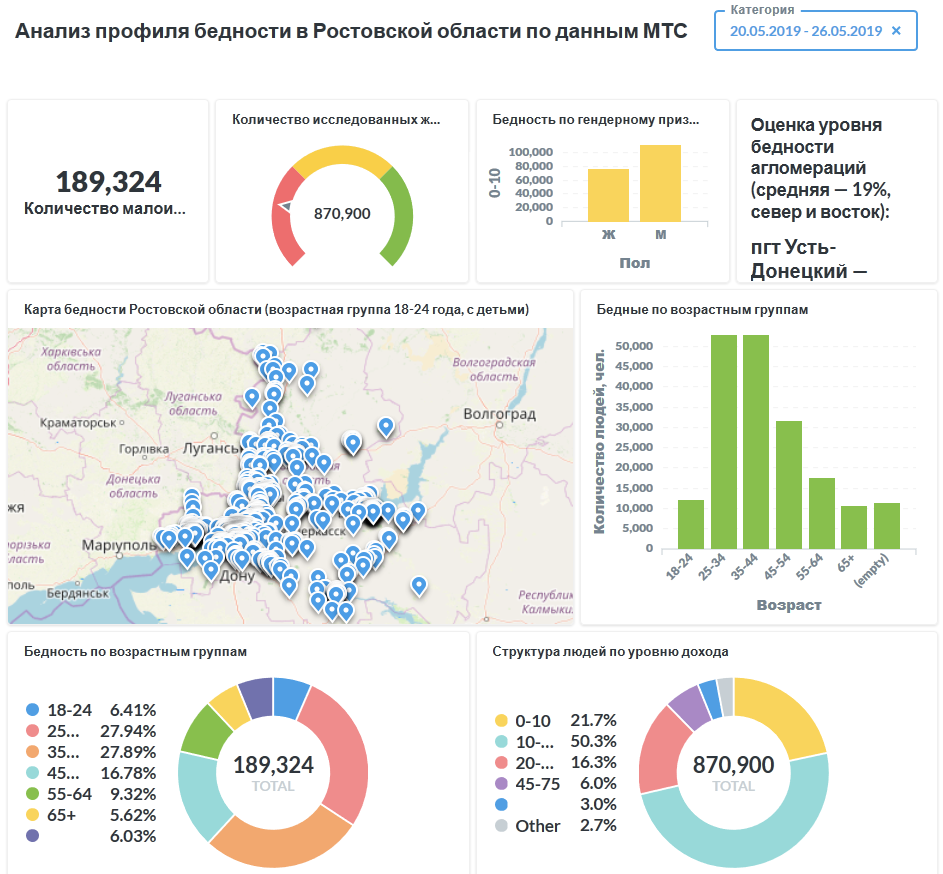
- geo-distribution of the poor population by poverty rate, age and gender
- targeted information of citizens about existing measures of social support (SMS-mailing)
- assessment of the level of potential poverty, incl. of those near the poverty line
- the distribution of the poor by types of preferred types of social contracts, according to the degree of concentration of needs
- integration of the solution into the administrative processes of the constituent entity of the Russian Federation, including the launch of targeted campaigns
- data from mobile operators, government organizations, open data sources were combined
- income and expenses, behavioral habits, the presence of an antisocial factor were analyzed, events preceding the poverty were identified
- development of preventive measures aimed at increasing the level of income
- on the basis of a comparative analysis, approaches to assigning the status of «those especially in need in social assistance» will be adjusted
- measures have been developed to get the poor out of poverty
- preventive measures have been developed aimed at increasing the level of income of families at risk (associal, who have lost sources of income)
Implemented applications — dashboards:
- Rostov Region
according to MTS: http://95.163.180.44/public/dashboard/1f4146e9-9298-4826-89f4-1ec26a3dee0b
according to Beeline: http://95.163.180.44/public/dashboard/d1b08e31-d4b2-4804-b1cd-dd5805b27ab4
- Lipetsk region
according to MTS: http://95.163.180.44/public/dashboard/a30ff714-3d66-4c01-a440-3728e9dd112e
according to Beeline: http://95.163.180.44/public/dashboard/b3098df7-a7c0-4606-8df3-f4cc00a11bab
according to Lipetsk Region: https://poverty.admlr.lipetsk.ru/public/dashboard/a59142b1-ecd6-427a-b917-0b872d154971
- The Republic of Sakha (Yakutia)
http://poverty.sakha.gov.ru/public/dashboard/f289a814-9eaa-43e5-8507-b5f557002ce1
Practice website
Social networks
Practice result
Main result:
Выявлены «мнимые бедные»
Выявлены «скрытые бедные» за счет проведения адресных таргетированных информационных акций
Additional results:
Определена разница между данными региональных информационных систем и сотовых операторов
Определен размер группы граждан, у которых существует риск стать бедным
Оказывается реальная поддержка гражданам с доходами ниже величины прожиточного минимума
Implementation cost: Up to 500 thousand ₽
Organizations
Сотовые операторы
ФНС РФ
ПФР
ЗАГС
Миграционные службы
Implementation features
Join the current project
IT-инфраструктура, IT-специалисты. Дополнительных затрат не требует.
Support with implementation
Внедрение сервиса осуществляется при поддержке АСИ и путем перераспределения внутренних ресурсов.
Implementation stages
2 month
Подготовительный этап